


Kelvin - Lighting Fundamentals
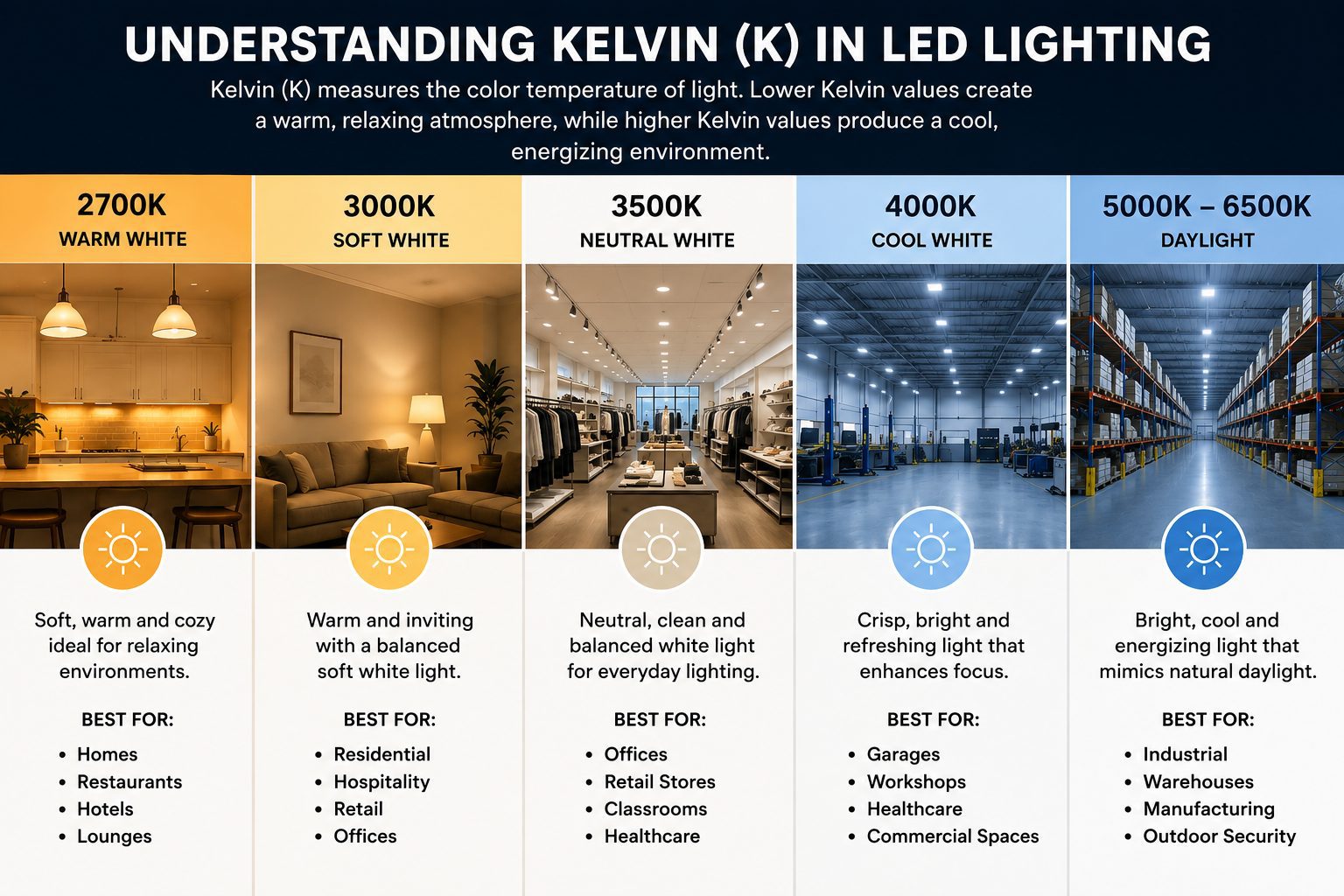
Color temperatures describe how warm or cool white light is processed by the human eye. Light is called warm white if it has orange and yellow tones, cold white if it is neutral, and daylight if it emits a slightly bluish tint hue.
Color Temperature in K (Kelvin)
Color temperature describes the visual appearance or color of light and is measured in Kelvin (K). The Kelvin scale generally ranges from approximately 1,000K to 10,000K, although most residential, commercial, and architectural lighting applications fall within a smaller range, typically around 2,000K to 6,500K.
Color temperatures are commonly described using terms such as Warm White, Soft White, Neutral White, Cool White, and Daylight. These descriptions can vary somewhat between manufacturers and applications, but they generally follow this progression:
- Warm White: 2600K–3000K — Produces a warm, yellowish appearance that creates a comfortable and inviting atmosphere. Common in residential spaces, restaurants, hospitality, lounges, and decorative applications.
- Soft White: 3000K–3500K — Provides a warmer white appearance with slightly more clarity than traditional warm white. Often used in residential areas, retail environments, hospitality, restaurants, offices, and general-purpose commercial lighting.
- Neutral White: 3500K–4000K — Offers a balanced white appearance between warm and cool light. It provides a clean, natural look without being noticeably yellow or blue. Common applications include offices, schools, healthcare facilities, retail stores, and general commercial spaces.
- Cool White: 4000K–4500K — Produces a crisp, clean white appearance with less warmth than neutral white. It is often used in commercial, industrial, retail, workshops, garages, and task-oriented environments where good visibility is important.
- Daylight: 5000K–6500K — Produces a bright, cool, daylight-like appearance with increased blue content. Commonly used in warehouses, manufacturing facilities, workshops, garages, refrigerated displays, task lighting, and applications requiring a crisp, high-visibility environment.
An Important Note About Kelvin
The terminology Warm, Soft, Neutral, Cool, and Daylight is not universally standardized. One manufacturer may classify 3500K as neutral white, while another may describe it as soft or cool white. The actual Kelvin value is the most reliable way to determine the color appearance of an LED product.
Remember:
Lower Kelvin = Warmer Light
Higher Kelvin = Cooler Light
For example, 2700K will have a warm, yellowish appearance, while 5000K will appear much cooler and more blue-white.